What is Forerunner 5 (fr5)?
Forerunner 5 is a comprehensive Python toolkit for chemical informatics and optimization, developed as part of the AIchemy project at Imperial College London. The package addresses the critical need for accelerating the translation of predicted materials and reactions from computational models to real-world applications.
Project Overview
The Forerunner 5 project focuses on "Identifying and Optimising Reaction Mechanisms" using advanced computational methods. Our goal is to develop an automated platform for reaction mechanism discovery that combines:
- Multi-fidelity ML models that integrate computational and experimental data
- Advanced optimization algorithms for efficient experimental design
- Automated property prediction for chemical systems
- Scalable workflows for high-throughput discovery
Core Capabilities
🧪 Molecular Descriptors
Generate comprehensive descriptors for various chemical systems:
- Ionic Liquids (ILs): Fragment-based and property-based descriptors
- Metal-Organic Frameworks (MOFs): Structural and topological descriptors
- Molecules: RDKit-based molecular fingerprints and properties
📊 Property Prediction
State-of-the-art machine learning models for predicting chemical properties:
Ionic Liquid Properties
- Viscosity prediction using CatBoost and neural networks
- Density estimation with temperature-dependent models
- CO₂ solubility prediction for green chemistry applications
MOF Properties
- CO₂ uptake capacity for carbon capture applications
- Pore volume and surface area characterization
- Adsorption isotherms prediction
Reaction Properties
- Reaction conversion prediction
- Selectivity optimization for multi-product reactions
- Mechanistic pathway analysis
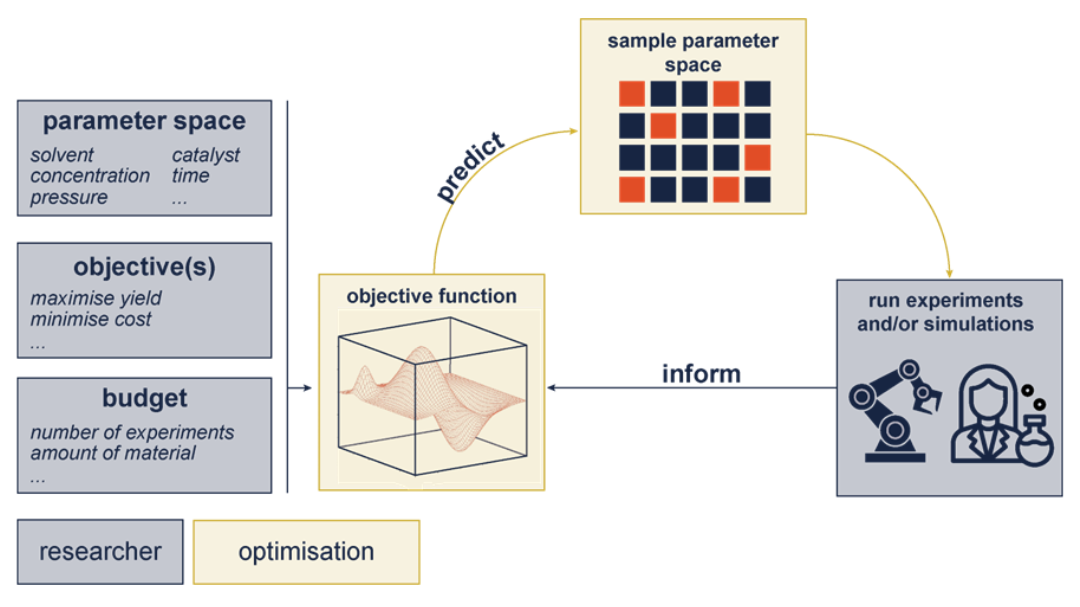
🎯 Bayesian Optimization
Advanced optimization framework for experimental design:
- Multi-objective optimization with Pareto front analysis
- High-dimensional Gaussian Processes with specialized kernels
- Adaptive acquisition functions for efficient exploration
- VAE-enabled optimization for categorical variables
- Batch optimization with constant variables
Key Features
✨ User-Friendly APIs
# Simple property prediction
from fr5.property_prediction_il import predict_viscosity

result = predict_viscosity({
    'cation': 'EMIM',
    'anion': 'BF4',
    'temperature': 298.15
})
⚡ High Performance
- Optimized algorithms for large-scale optimization
- GPU acceleration for neural network models
- Efficient caching and memory management
- Scalable to thousands of experiments
🔬 Scientific Rigor
- Validated on experimental datasets
- Cross-validated model performance metrics
- Uncertainty quantification for predictions
- Reproducible workflows and random seeds
🔧 Extensible Design
- Modular architecture for easy extension
- Plugin system for custom models
- Flexible data I/O with multiple formats
- Database integration for experiment tracking
Integration with AIchemy Ecosystem
fr5 is designed to integrate seamlessly with other AIchemy tools and workflows:
- Data management: SQLite and Excel integration for experiment tracking
- Visualization: Built-in plotting with matplotlib and plotly
- Parallel computing: Support for distributed optimization
- Cloud deployment: Docker containers and cloud-ready APIs
Target Applications
The fr5 toolkit is particularly valuable for:
🏭 Industrial Applications
- Process optimization in chemical manufacturing
- Catalyst discovery and optimization
- Solvent selection for green chemistry
- Reaction condition optimization
🔬 Academic Research
- High-throughput screening of chemical libraries
- Mechanistic studies of complex reactions
- Material property prediction and design
- Multi-objective optimization studies
💡 Innovation Acceleration
- Rapid prototyping of new chemical processes
- Data-driven discovery of novel materials
- Automated experimental design
- Knowledge extraction from chemical databases